

 +92 3164838761
A revise and resubmit is a conditional yes. The editor has spent reviewer time and queue space because they believe your paper can make it. It is also where publications are won or lost, since a defensive, incomplete or messy reply can sink a paper the reviewers were ready to accept. Our resubmission support turns that decision letter into a plan and a response letter.
Decision letters from every major publisher system land on our desks, including Elsevier, Springer Nature, Wiley, Taylor and Francis, Emerald, SAGE, IEEE and MDPI. Formats differ. The craft of answering does not.
What is included
- Comment by comment decoding: what each reviewer point actually requires, which ones carry weight, and what the editor’s own paragraph says to prioritize.
- Revision planning: comments sorted into quick fixes, substantive work and the few genuinely contestable points, with an effort estimate against your deadline on day one.
- A point by point response letter in the numbered, quoted and located format editors expect, with a tone that balances confidence and respect.
- Disagreement strategy: how to decline a reviewer request with evidence, and how to flag contradictory reviewers so the editor can decide.
- Support for new analyses: when a reviewer asks for a test you have not run, SPSS and data analysis coaching gets you through it on your own data, reported correctly.
- Editing of the revised paper: every new or rewritten passage is polished before it goes back, because round two prose gets read against round one polish.
How we triage reviewer comments
Comment type | What it usually means | Response |
Missing analysis | Reviewers doubt a central claim | Add the analysis, or narrow the claim |
It is not clear why | A choice was never justified | Fix the paper, then say so in the letter |
Cite these papers | A relevant gap, or self citation pressure | Cite what fits, decline politely otherwise |
Reviewers disagree | The editor must choose | Flag the conflict and explain your reading |
Request beyond your data | The work cannot be done | Offer a defensible alternative with evidence |
What goes back to the journal
A clean copy of the revised paper, a tracked changes version, and the point by point response letter. Journals that use double anonymized review also need an anonymized copy. The letter is written by you with our guidance, so the answers and authorship stay yours, and every change you claim is checked against the paper before you resubmit.
Deadline discipline
Revision windows usually run 4 to 12 weeks, and journals grant sensible extensions when asked early with a specific date. Each engagement is scoped to your journal’s deadline at the quote stage, and you hear plainly if a date cannot be met to standard, because a rushed partial reply performs worse than a two week extension. For candidates racing a graduation date, a revise and resubmit is the strongest position there is: one complete response and one editorial cycle from acceptance.
Rejections that come with reviews
A rejection with substantive referee reports is free expert consulting on your paper. The right comments get extracted, the revision gets planned, and the work pairs with journal selection and submission support so the improved paper goes to a journal that fits instead of the next name down a list.
How it works
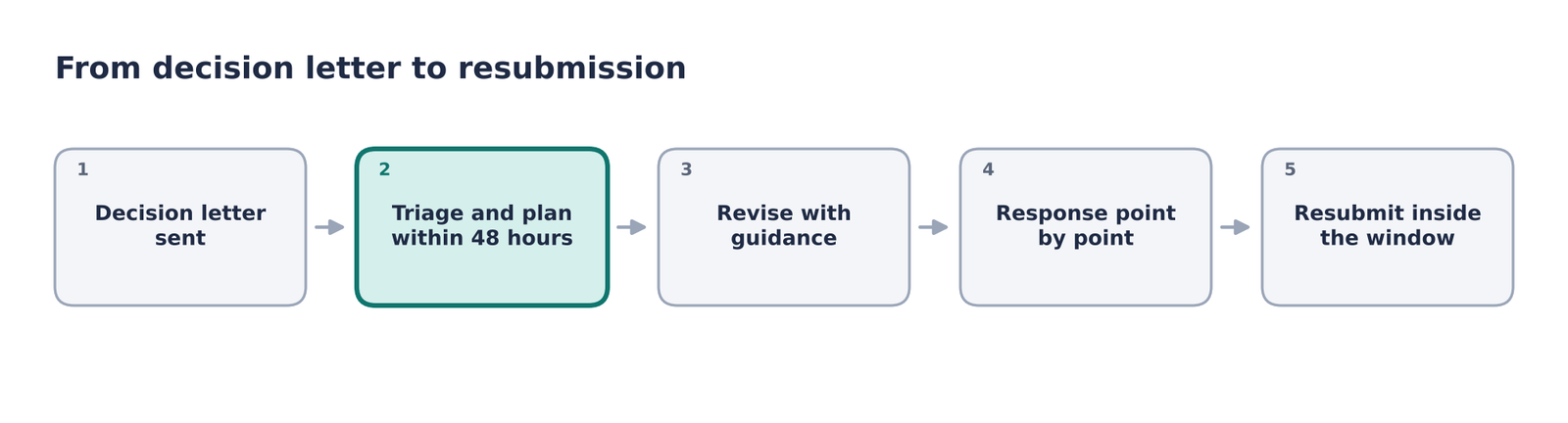
- Send the decision letter and the paper. Include the full letter with the editor’s summary, ideally within a day of receiving it, since the value of triage fades with the deadline.
- Triage and plan within 48 hours: comment classification, priorities, effort estimate, and an extension recommendation if one is needed.
- Revise and respond. You make the substantive changes with guidance, the response letter gets structured, the revision gets edited, and the work is checked before you resubmit.
Reading what reviewers actually mean
Reviewers write in a dialect of academic politeness, and misreading it costs papers. The manuscript would benefit from means do it. The authors may wish to consider means do it or decline with evidence. It is not clear to this reviewer why means your writing failed to justify a choice, so the fix belongs in the paper and not only in the letter. The contribution is unclear means the introduction is not doing its job, and it is the most common substantive comment in existence. Some relevant literature appears to be missing usually means cite these, and occasionally means cite me, a request you may politely decline. Part of what you are buying is a translator who has sat on both sides of that correspondence.
Four ways authors lose a revise and resubmit
The first is cosmetic compliance, where a sentence gets softened in answer to a request for an analysis, and reviewers who check their own comments notice immediately. The second is combat mode, where the letter becomes a rebuttal brief that wins arguments and loses the paper. The third is scope creep, where the revision adds everything the paper should have had and invites objections nobody saw coming. The fourth is the silent deadline slide, where the window lapses without contact and a revise and resubmit quietly becomes a withdrawal. All four are avoidable, and avoiding them is the substance of this service.
Related help
If a reviewer asks for deeper structural work, scientific editing covers it, and English editing services polish every new passage. To avoid a rough first round next time, a referee report before you submit shows you the problems early. The Complete tier of the publication support packages includes one full resubmission round.
Who this is for
Authors holding a revise and resubmit or a rejection with substantive reviews, teams facing contradictory reviewers, and anyone whose revision demands analysis beyond their current toolkit.
Resubmission support questions
What are my odds after a revise and resubmit? Better than the tone of the letter suggests. Most published papers passed through at least one major revision, which makes revision then acceptance the usual path. Conversion depends overwhelmingly on the quality of the response, and that is the part this service controls.
A reviewer is simply wrong. Can you help me say so? Yes. The craft is saying it once, politely, with sources, after checking whether unclear writing caused the misreading. That is the more common truth, and its fix is a clarification rather than a correction.
The journal rejected us but invited resubmission. Is that the same service? Yes, treated as a major revision plus a fresh look at structure. If the version the journal wants is not a paper you want to write, you will hear that and the reviews will be redirected to a journal that fits better.
Send your decision letter and paper today and the plan arrives within 48 hours. Get a free quote.