
 +92 3164838761
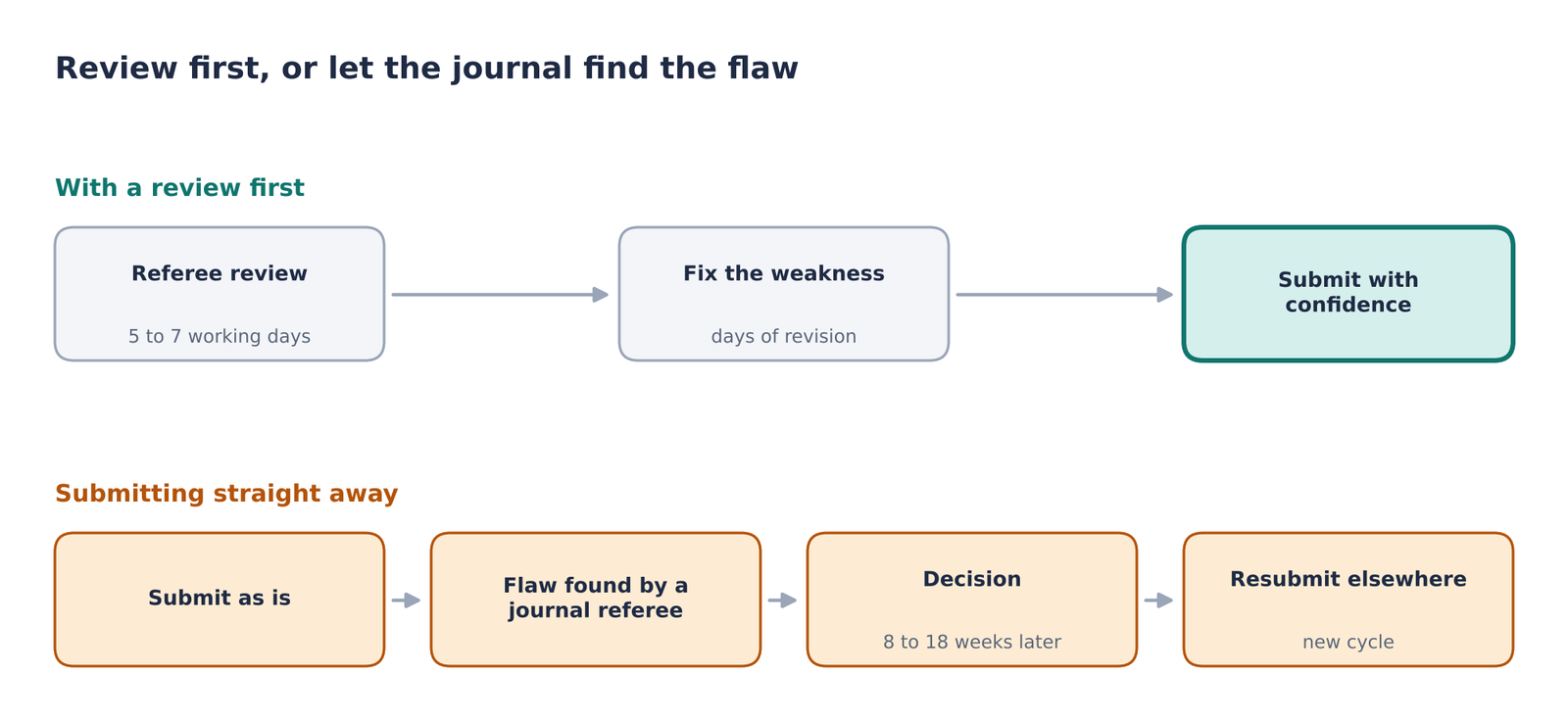
Every paper gets peer reviewed eventually. The only choice is whether the first hard look comes before submission, when fixes take days, or after, when it costs a rejection plus the 8 to 18 weeks a first decision usually takes. Our pre submission peer review is a genuine referee style assessment by an academic who reviews for indexed journals in your field. You get the lens a Scopus or Web of Science referee would apply, as a structured written report, while there is still time to act.
What your report covers
- Contribution and significance: is the point of the paper clear, and is it set against the right current literature?
- Methods and rigor: design, sampling, analysis choices, and whether the reporting would survive referee scrutiny at your target tier.
- Structure and argument: abstract through conclusions, including anything a referee would flag as overclaiming.
- Reporting completeness: tables, figures, statistics presentation and field norms such as APA statistical reporting or a PRISMA flow for reviews.
- Prioritized recommendations: what to fix before submission, ordered by impact.
- A readiness verdict: an honest read on whether the paper is ready and for which tier, such as a realistic call between an SSCI Q1 target and a strong Scopus Q2 outlet, with reasons.
Reviewed by people who actually referee
The report is written by an academic with active peer review experience for journals in your discipline, and it carries the reviewer’s field credentials. That matters because referee standards are learned by refereeing. What a Computers & Education reviewer expects from an education technology paper, or what a British Journal of Management referee does with an under justified sampling frame, is knowledge that comes from the reviewer’s chair. Journal names here illustrate the standard applied and do not promise placement.
What the report is not
It is not a formal journal review and carries no standing with any journal, and it is never presented as one. Think of it as an expert rehearsal of the review your paper is about to face, written to be more useful than a real referee report because it is allowed to tell you how to fix things instead of only what is wrong. Your manuscript stays confidential throughout.
The economics of hearing it early
Desk rejection claims a large share of submissions at individual journals, and first decisions with review usually take 8 to 18 weeks. A weakness found here costs days of revision. The same weakness found by a referee costs that full cycle, then a resubmission elsewhere, then another cycle. For a doctoral candidate racing a viva date or a lecturer facing a promotion deadline, the gap decides whether the requirement is met or missed. It is the cheapest insurance available on a paper that already took years to produce.
What a report looks like
Reports run several pages and read like a structured referee assessment: a summary judgment on readiness and appropriate tier, then section by section commentary keyed to page and line, then a prioritized action list that separates must fix items from improvements worth making if time allows. Where an analysis is questioned, the report names the alternative a referee would ask for, so you can run it or prepare the argument for skipping it. Where the contribution is unclear, the report drafts the one sentence version for you to accept, reject or improve. Generic feedback is what supervisors and colleagues already give for free, so nothing in it is generic.
What to do with your report
Many authors commission scientific editing next, aimed at exactly what the review found. The readiness verdict turns into a verified shortlist through journal selection and submission support. The Complete tier of the publication support packages runs the review first and the edit second. If a journal later asks for revisions, resubmission support picks up from there.
How it works
- Submit the paper with your intended target or requirement. The report takes 5 to 7 working days.
- Receive the structured report with prioritized fixes and the readiness verdict.
- Act on it your way. Revise on your own, or pair the report with editing so the edit targets what the review surfaced.
Who this is for
First submissions to competitive journals, early career researchers who have never been through review, authors whose last paper was desk rejected without clear reasons, and anyone publishing under a deadline who cannot afford a wasted cycle.
Pre submission peer review questions
How is this different from scientific editing? Editing improves the paper directly. A review assesses it and tells you what to improve, in a referee’s voice. Many authors take the review first and commission editing for what it found. The package bundles both at a saving.
Will the review be gentle? Fair, constructive and honest. A comfortable review that hides problems only hands the pain to the journal’s referees, at ten times the calendar cost. This one exists so their report is the easy one.
Can the reviewer tell me which journal to target? The readiness verdict includes a tier judgment, and pairing it with journal selection turns that judgment into a verified shortlist. The two services are designed to fit together.
Is this a real journal review? No. It is an expert rehearsal, written by someone who referees for indexed journals, so the first real review of your paper is the easy one.
Send your paper and your target for a free assessment. Get a free quote.