
 +92 3164838761
Most desk rejections have little to do with grammar. Editors keep citing the same causes: the contribution is unclear, the methods section fails to convince, or the discussion never delivers what the introduction promised. Scientific editing exists to fix those problems.
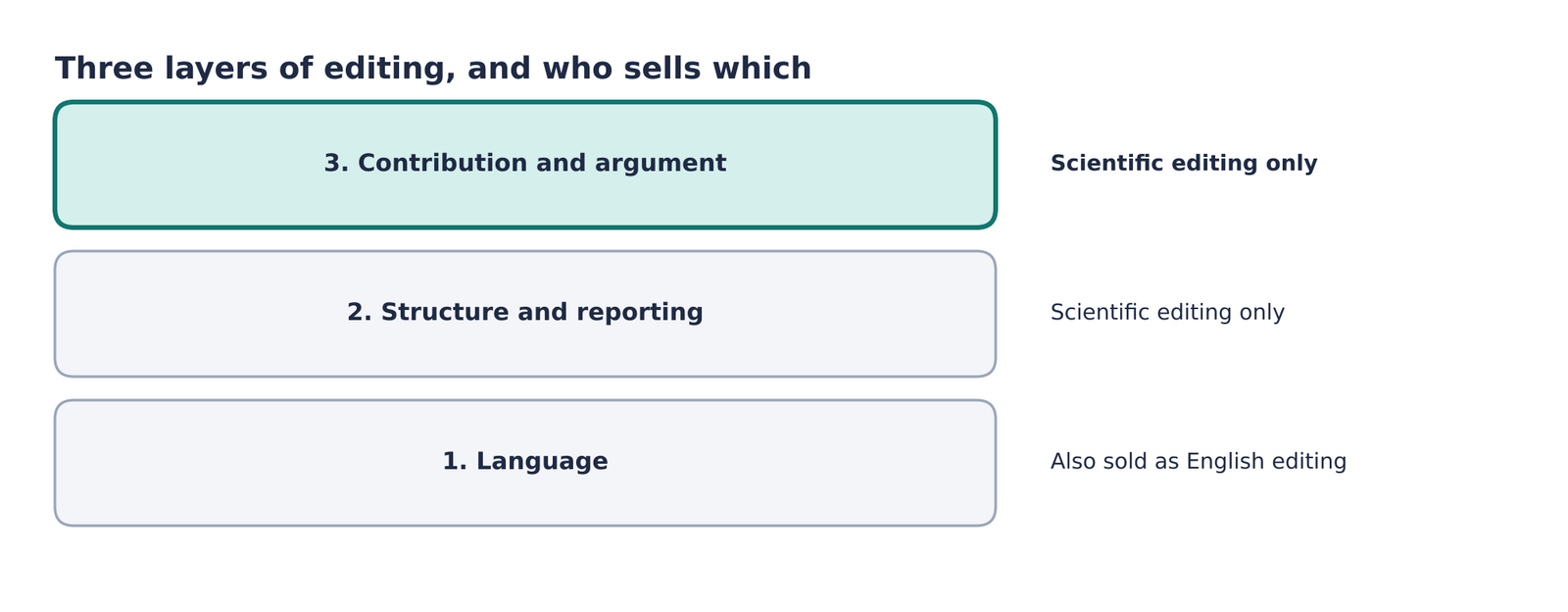
A subject expert, an academic with publishing and peer review experience in your discipline, works on the substance of your paper. They look at how the contribution is framed against current literature, whether the argument holds from abstract to conclusion, whether the methods reporting would survive referee scrutiny, and whether results, discussion and claims line up. Full language editing is included, so there is no need to buy English editing services separately. The value sits in everything beyond it.
What is included
- Contribution and novelty framing: sharpening how the abstract and introduction position the study, the most common substantive weakness reviewers name.
- Structural editing: section balance, flow and IMRaD alignment.
- Methods reporting review: completeness, replicability, and justification for design and analysis choices.
- Coherence between results and discussion: claims matched to evidence, limitations handled credibly, no overclaiming.
- Full language editing, as described on the English editing page.
- An editor’s report: a written summary of the substantive issues addressed and the decisions that remain yours.
Copy editing, substantive editing and scientific editing
Level | Scope |
Copy editing | Grammar, spelling, consistency |
Substantive editing | Logic, structure, presentation, flow of content |
Scientific editing (this page) | Substantive editing plus contribution framing and methods reporting by a subject expert |
Editors who know your journals from the reviewer’s chair
Our scientific editors hold faculty positions and review for indexed journals in their fields, which changes what they notice. In business and management that means familiarity with SSCI outlets ranked on the ABS Academic Journal Guide and the ABDC list, from flagship titles such as the Journal of Management Studies and the British Journal of Management down to solid Scopus indexed regional journals. In computer science and education it means SCIE and SSCI venues such as IEEE Access and Computers & Education. In health sciences it means the reporting standards of PubMed and Medline indexed titles. These names illustrate tiers and are not promises of placement. Every journal decision belongs to its editors and referees, and any service claiming otherwise is one to avoid.
Disciplines covered
Business and management, economics and finance, education, computer science and information systems, engineering, public health and nursing, psychology, and the social sciences. Where a paper sits between fields, the editor is matched to the journal you are aiming for rather than the topic label, because the target journal’s conventions are what the referees will apply.
What the editor’s report usually finds
The findings cluster in predictable places. The contribution appears in the discussion but never in the abstract, so a desk editor reading the first 200 words never learns why the paper exists. The introduction promises a theory testing study while the discussion delivers theory extension, which reviewers read as confusion rather than the interesting result it often is. The methods section explains what was done but not why that design answers this question, the gap referees probe hardest. Results include analyses that serve no stated hypothesis, which invites the question of what else was run. Limitations are either missing or so sweeping that they undermine the study. And claims outrun the design, usually through causal verbs on cross sectional data. Each of these can be fixed in days now and can be fatal three months from now.
Where scientific editing stops
An editor cannot collect data you did not collect, run a study you did not design, or invent a contribution the research does not contain. Where the underlying work has a real gap, the report says so plainly and tells you what would close it, whether that is a robustness check, a reframed research question or a more modest set of claims. Hearing this before submission is uncomfortable and far cheaper than hearing it from referees after a full review cycle. If you want an assessment before any editing, a peer review before submission tells you how ready the paper is and which tier fits.
Where it fits on the route to publication
After the edit, journal selection and submission support finds the right home for the paper. When reviewers have already replied, resubmission support keeps the response letter and the revision moving together. The publication support packages combine these steps at a fixed price.
How it works
- Free assessment. The paper gets read and you hear honestly whether it needs scientific editing or the lighter language service.
- Substantive edit. Tracked changes and margin reasoning on structure, framing and reporting, with the editor’s report attached.
- Decision support. The report separates what was fixed from what only you can decide, such as a missing robustness check or a claim to soften.
Who this is for
Authors targeting Scopus and Web of Science journals, especially at Q1 and Q2 level where substantive standards decide outcomes, researchers whose last submission was desk rejected, and anyone whose reviewer feedback pointed at structure, contribution or methods instead of language.
Scientific editing questions
Will the editor rewrite my paper? No. Scientific editing strengthens what you wrote and flags what only you can fix. Substantive suggestions arrive as tracked changes and comments, and authorship and intellectual content stay yours, in line with COPE publication ethics.
Reviewers said our contribution is unclear. Is this the right service? Yes, that comment is exactly what contribution framing addresses. If you are answering reviewers rather than preparing a first submission, add resubmission support so the response letter and the revision move together.
Can you edit toward a specific ABS or ABDC ranked journal? Editing follows the conventions of the tier and outlet you name, and its current indexing, quartile and ranking are verified at consultation. Acceptance is never promised at any ranked journal, because nobody honestly can.
Send your paper for a free read and an honest recommendation. Get a free quote.